 |
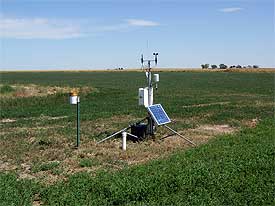
Weather Station
Photo courtesy Dr. Mike Bartolo, PhD |
|
Colorado State University Agricultural Water Conservation Website
The Water Center brings together a rich history in water related education and research with diverse talent from 25 different departments at Colorado StateUniversity to form a group of educators and researchers interested in water resources.
Sustainable Agriculture in Colorado
Created to find solutions to the growing challenges that face our Colorado farms and ranches. Programs such as water quality, value-added, and niche marketing are helping Colorado improve the local economy, communities, and their livelihoods.
www.smartditch.com
There are vast potential savings opportunities from water conservation measures in ditches and canals servicing the world's food and livestock production. SmartDitch™ liners can increase water distribution in gravity-fed irrigation systems by as much as 90 percent - and at substantially lower costs than with alternative methods such as concrete or pipe.
Limited Irrigation Management
Full irrigation is the amount needed to achieve maximum yield; however, when irrigation water is insufficient to meet crop demand, limited irrigation management strategies should be considered. These strategies manage the limited water to achieve the highest possible economic return. Restrictions on water supply are the primary reasons for using limited irrigation management. These restrictions may come in the form of mandated water allocations, from both ground water and surface water supplies, low yielding wells, or drought conditions which decrease available surface water supplies.
The key management choices for dealing with insufficient irrigation supplies are to: 1) reduce irrigated acreage; 2) reduce amount of irrigation water applied to all acres; 3) substitute low-water requirement crops for high-water requirement crops; 4) delay irrigation until a critical water stage; and 5) manage soil moisture to capture precipitation.
University of Nebraska – Irrigation Operation and Management
Crop residue cover and tillage practices play important roles in the way that crops use water, and also affect the ability of irrigation systems to replace that water. The effects of these practices and other influencing factors are discussed in this NebGuide. Tillage practices and crop residue management play an important role in the way that irrigation systems perform and are managed. Tillage practices affect the way that water moves into and off of the soil (infiltration and runoff). Tillage practices also affect the way that water moves from the soil into the atmosphere (evapotranspiration).
Selecting and Using Irrigation Propeller Meters
This NebGuide discusses the use of propeller type irrigation meters to monitor irrigation water use. Measuring irrigation water is important in efficient water management. Measuring water can be used for the following purposes: Checking irrigation efficiency, determining pumping plant efficiency, and detecting well and pump problems.
Irrigation Scheduling: The Water Balance Approach
- Irrigation scheduling by the water-balance approach is analogous to running a checkbook balance.
- Advertised evapotranspiration rates can be used to run water balance and schedule irrigation.
- Ready-to-use computer programs facilitate the use of the water-balance approach in irrigation scheduling.
- Soil water-content measurements are needed as a safety check on the predicted water content and irrigation timing.
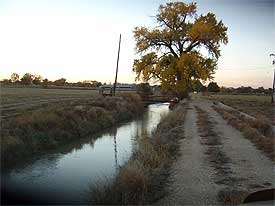 |
Irrigation canal
Photo courtesy Dr. Mike Bartolo, PhD |
|
Seasonal Water Needs and Opportunities for Limited Irrigation for Colorado Crops
- Knowing seasonal crop water requirements is crucial for planning your crop mixture.
- Net crop requirements are estimated using models, based on weather variables.
- To water for the greatest return, producers need to understand how crops respond to water, how crop rotation enhances water availability, and how changes in agronomic practices effects water needs.
Colorado High Plains Irrigation Practices Guide
Provides a summary of the documented water savings options for irrigators in Colorado. It provides details regarding what options are available from water conservation, how these options are used to conserve water and expected water savings that can be achieved.
McCrometer’s Propeller meters
McCrometer has set the standard for propeller flowmeter technology in the agricultural and turf markets since 1955. Its uniquely-designed Mc Propeller line offers an economical and versatile flow measurement solution for a wide range of water applications, and is especially suited to dirty water flows.
Netafim Drip Irrigation Products
Netafim offers a full range of products to satisfy all your drip/micro irrigation needs – including dripperlines, sprinklers, filters, valves, crop management technologies and other vital system support - such as technical education and agronomic expertise.
Diversity D Inc. – Specializing in Drip Irrigation
Diversity D offers consultation, design & installation for new systems. In addition, they offer service for existing systems.
Mobile Irrigation Labs (MILs)
Specialized labs on wheels developed to help people conserve water by evaluating irrigation systems and their operation. It is offered as a free public service to both the urban and agricultural communities.
Water Budget Scheduling
Kansas State Irrigation Software
Using ET Reports for Center Pivot Irrigation Scheduling:
Using ET Reports for Furrow Irrigation Scheduling:
ET Primer
Predicting Final Irrigation
Spectrum Technologies Incorporated - Weather and environmental monitoring, nutrient management, soil and water quality and IPM management resources.
The Family Farm Alliance is a powerful advocate for family farmers, ranchers, irrigation districts, and allied industries in seventeen Western states. The Alliance is focused on one mission - To ensure the availability of reliable, affordable irrigation water supplies to Western farmers and ranchers.
Agriculture Water Conservation Clearinghouse
This website is a clearinghouse of information about agricultural water conservation. The project's goals are to increase access to information which will help build collaborative relationships between and among agencies region and nation-wide, provide technical expertise regarding agricultural water conservation, and offer detailed information on the management, policies, and laws surrounding agricultural water conservation.
2008 Farm Bill
Institute of Environmental Solutions-Tree Scapes
TRUEPOINT SOLUTIONS provides focused software solutions and services for water agencies, special districts and local government agencies.
GIS and Web Services for Irrigation Districts
Waterman Water Control and Irrigation Equipment
Ditch and Reservoir Company Alliance
www.toromicroirrigation.com
|